
Views: 0 Author: Site Editor Publish Time: 2026-01-19 Origin: Site


Fuel injectorsare core components of modern internal combustion engines, directly determining power output, fuel efficiency, and operational stability. Timely identifying signs of bad fuel injectors, mastering fuel injector cleaning techniques, and selecting compatible replacements can effectively prevent minor issues from escalating into severe damage. This guide, based on industry expertise, systematically breaks down the injector’s working principle, warning signs, diagnostic methods, and solutions—with clear tables and practical advice for easy reference.
At its heart, a fuel injector’s job is to maintain the perfect air-fuel mixture:
• An internal electromagnetic solenoid opens and closes in sync with the engine’s timing, spraying high-pressure fuel through the nozzle as a fine mist.
• The vehicle’s ECU (Electronic Control Unit) continuously monitors air composition and adjusts the injector’s fuel delivery volume and timing.
• Good atomisation is key to efficient combustion—well-functioning injectors ensure fuel mixes evenly with air for optimal performance.
In simple terms, the injector’s "precision in opening/closing" and "atomisation quality" are fundamental to smooth engine operation.

Symptom | Core Cause | Potential Risks |
1. Poor Fuel Economy (Increased Fuel Consumption) | ECU compensates for an imbalanced air-fuel mixture by demanding more fuel from the injector | Long-term fuel waste and higher running costs |
2. Rough Idle & Engine Vibration | Insufficient or uneven fuel delivery at idle, leading to incomplete combustion in cylinders | Accelerated wear of pistons and spark plugs |
3. Fuel Odour (In Cabin or From Exhaust) | Stuck-open solenoid in the injector, or unburned fuel leaking | Safety hazards and environmental pollution |
4. Loss of Power & Frequent Stalling | Clogged injector restricting fuel supply, or stuck solenoid | Dangerous stalling while driving; disrupted work/travel |
5. Erratic RPM Needle (Fluctuating Engine Speed) | Sudden spikes or drops in fuel delivery, which the ECU cannot compensate for quickly | Unstable engine operation; damage to other components |
6. Engine Misfire | Injector fails to deliver enough fuel to support combustion | Unburned fuel damages the catalytic converter; exhaust system issues |
7. Foul-Smelling Exhaust & Failed Emissions Tests | Incomplete fuel combustion, leading to excessive unburned hydrocarbons in exhaust | Environmental fines; damage to exhaust system parts |
8. Fuel Leakage (Oil Stains on Parking Surface) | Severe injector clogging causing fuel rail leaks, or aged fuel hoses | Risk of engine bay fire in high-temperature environments |
9. Check Engine Light Illuminates | Imbalanced air-fuel mixture, misfires, or other issues triggering the on-board diagnostic system | Fault escalation; potential damage to ECU or fuel pump |


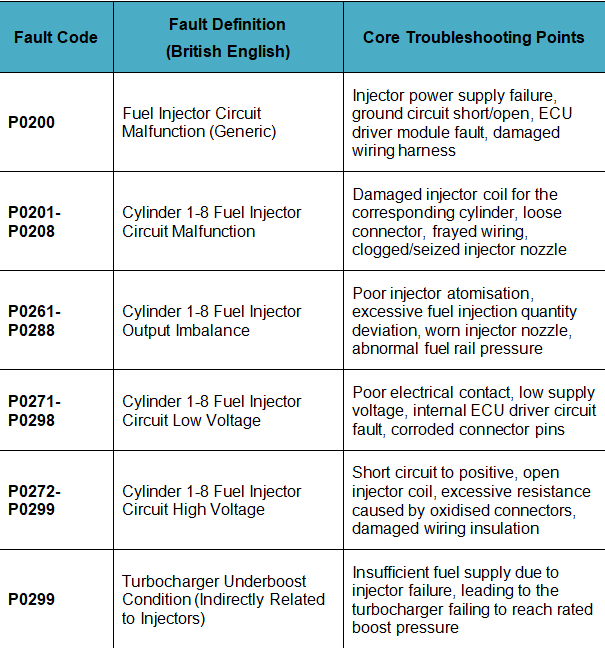
When the check engine light comes on, an OBD II scanner can retrieve codes to pinpoint the problem:
• Air-fuel mixture issues: P0171 (lean mixture), P0174 (rich mixture) – likely caused by a clogged or leaking injector.
• Cylinder misfire location: P0201-P0208 (the last digit indicates the cylinder number) – directly points to the injector in the corresponding cylinder.
For example, fault code P0203 means "No. 3 cylinder injector malfunction," allowing targeted inspection of that injector’s solenoid and nozzle.
OBD-II Generic Trouble Codes
Treatment Method | Suitable Scenarios | Cost Range | Difficulty Level | Expected Outcome |
DIY Cleaning | Mild symptoms (slight rough idle, slightly increased fuel consumption); injector age < 45,000 miles | Tools + cleaner: 20-125 | Moderate (basic mechanical knowledge required) | Restores fuel atomisation; relieves mild clogging |
Professional Cleaning | DIY cleaning ineffective; obvious symptoms (power loss, RPM fluctuations) | 75-250 (full cylinder cleaning) | Low (performed by professional garages) | Deep carbon deposit removal; restores solenoid sensitivity |
Injector Replacement | Severe clogging, leakage, solenoid failure; injector age > 100,000 miles | 350-900+ (parts + labour, increases with number of cylinders) | High (professional installation recommended) | Fully restores engine’s original performance |
Selection Logic: Clean first, replace if necessary. For mild symptoms, try cleaning; if misfires, leaks, or other issues persist after cleaning, replacement is more cost-effective (avoids accumulated repair costs).
5.1 DIY Fuel Injector Cleaning Steps
1. Consult your vehicle’s service manual for safe injector removal guidelines.
2. Choose a compatible fuel injector cleaning kit (e.g., Mophorn, 8MILELAKE) and select adapters/nozzles that match your injector size.
3. Disconnect the vehicle’s battery negative terminal and attach the cleaning kit adapter to the injector.
4. Insert the kit’s spray nozzle into the injector opening to ensure a tight seal.
5. Connect the cleaning aerosol can to the kit adapter; hold the adapter with one hand and touch the red clip to the battery positive terminal for 1 second (triggers solenoid opening and cleaner spray).
6. Repeat step 5 5-7 times in 1-second bursts to remove nozzle deposits.
7. Check the spray pattern—uniform spray without backflow indicates successful cleaning.
8. Reinstall the injector in reverse order of removal, start the vehicle, and clear fault codes.
5.2 Key Steps for Injector Replacement (Professional Installation Recommended)
1. Allow the engine to cool completely, park on a level surface, and disconnect both battery terminals (wrap in insulating tape).
2. Remove the engine plastic cover and disconnect the fuel line from the fuel rail using a wrench.
3. Carefully disconnect the injector’s electrical connector with pliers to avoid damaging wires.
4. Lift the fuel rail with a ratchet wrench and remove the old injector (handle gently to prevent fuel leakage).
5. Wipe the fuel rail interface with a clean cloth and inspect the seal condition.
6. Clip the new injector into the fuel rail, ensuring a secure fit.
7. Reinstall all components in reverse order; connect the battery positive terminal first, then the negative.
8. Turn the key to "ON" and wait 10 seconds (allows fuel pump to pressurise); start the engine after confirming no leaks and let it idle until RPM stabilises.
6. Daily Maintenance Tips for Fuel Injectors
1. Cleaning Interval: Clean every 45,000-50,000 miles, or synchronise with every second fuel filter replacement.
2. Additive Use: Pour a high-quality fuel injector cleaner (e.g., Chevron Techron, Liqui Moly) into the fuel tank every 2,000-3,000 miles to prevent carbon deposits.
3. Fuel Selection: Always use high-quality fuel that meets your vehicle’s requirements to avoid nozzle clogging from impurities.
4. Timely Repairs: Address mild symptoms (e.g., increased fuel consumption, rough idle) promptly to prevent solenoid failure or fuel rail leakage.
7. Frequently Asked Questions (FAQ)
Q1: Can a faulty fuel injector damage the engine?
A: Yes. Long-term misfires wear pistons and cylinders; fuel leaks can cause engine bay fires; unburned fuel damages the catalytic converter—all leading to higher repair costs.
Q2: Can I replace fuel injectors myself?
A: Only recommended for experienced home mechanics. Injector installation involves the fuel pressure system; improper operation risks fuel leakage or electrical shorts. Ordinary users should prioritise professional services.
Q3: Does fuel injector cleaner 100% prevent clogging?
A: No, but it significantly reduces the risk. It breaks down residual deposits in the fuel system, optimises injector atomisation, and is a low-cost maintenance method.
Q4: What should I do after replacing fuel injectors?
A: Start the engine and let it idle for 5-10 minutes; clear fault codes with an OBD II scanner after confirming no leaks; take a short test drive to ensure normal power and idle.


